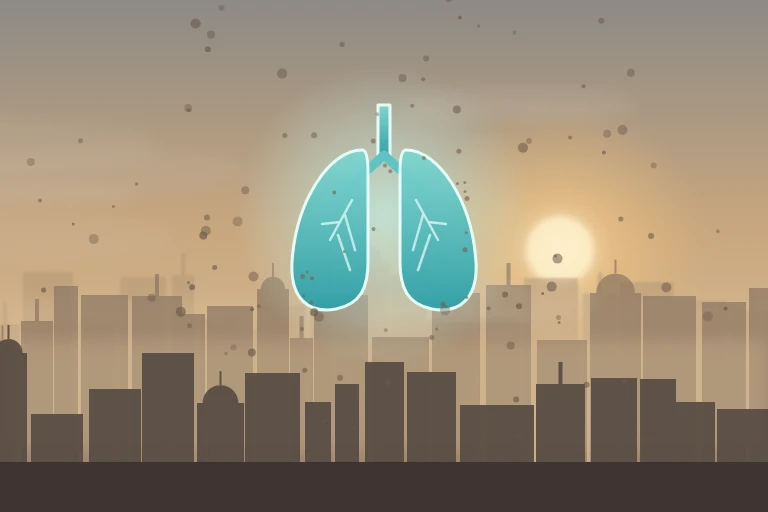
Delhi’s Air Making You Cough? Is It Only Pollution?
A simple guide to cough, airway irritation, asthma, COPD and when to seek medical help.
Dr Manish Garg | Pulmonologist | Delhi
A cough that feels familiar in Delhi
If you reside in Delhi or the NCR region, then you might be familiar with this: a scratchy throat on the way to work, a cough after a stroll outdoors, or a tight chest when the sky gets grey. These symptoms are more likely to be seen during poor air quality. Pollution may be one of the causes, however, in some cases, a cough can happen due to other factors. The nature and severity of the symptoms may be different from person to person depending on the degree of exposure. But, if the symptoms do not resolve, then it is worthwhile to undergo medical evaluation.
What is in polluted air?
Air pollution is presence of fine particles and gases generated by human activities – like transportation, industrialization, combustion of waste products and fuels – in the air. Fine particles named PM2.5 are very tiny and can go deep into lung tissues. Larger inhalable particles such as PM10 do not reach deep into the lungs but can irritate the nose, throat, and air passages.
Particles of polluted air irritate the lining of the breathing passages, making them more sensitive and fragile. As a result of this, there can be coughing, sore throat, wheezing, mucus production, and breathlessness. Those people who have heart or lung ailments, children, elderly people, and pregnant women are highly prone to pollution.
How does pollution trigger Asthma?
Asthma is a kind of inflammatory and hyper-reactive disorder of air passages. The muscle walls of airways contract, while there is thickening of the airway lining.
Coughing, wheezing, tightness in the chest, and breathing difficulties result from pollution. Pollution may worsen the existing Asthma conditions. In some individuals, there may be no wheezing, but only a constant cough that gives a hint that you may have Asthma.
In case you suffer from Asthma, you should adhere to your treatment plan and action plans as already prescribed by your doctor. You should not change the strength and frequency of your inhalers or quit them even when the weather improves or AQI level changes.
What about COPD?
Chronic Obstructive Pulmonary Disease is an illness of the lungs which cause chronic cough and production of mucus, or even chronic shortness of breath. This disease is associated with smoking, but other exposures can also be reason for development of COPD. Polluted air can make the condition worse and cause sudden worsening of symptoms which is called – exacerbation of COPD.
Possible signs of exacerbation of COPD are an increased feeling of breathlessness, a change in the volume or color of mucus production, worsening of cough, and further sudden reduction in capacity to conduct daily tasks.
COPD patients must always have prescribed medicines available with them and use the inhalers correctly following the COPD Action Plan developed by their clinician.
Is every cough caused by pollution?
No. The other causes of cough are allergies, sinus or nose discharge, heartburn, smoking, some specific medications, infections such as virus (COVID-19) or flu. At times, it may be heart diseases that may cause shortness of breath and cough.
The cough after exposure to pollution is the indicator of irritation, but it may not be sufficient to prove it up. If the cough is persistent and recurring or is associated with any other symptoms, the doctor will go through your medical history, carry out a physical examination to find out whether you need any investigations including chest X-ray and other investigations.
Practical ways to reduce exposure.
Don’t depend only on visibility in the sky, rather check the AQI of your area as per the Central Pollution Control Board’s website. When air pollution is severe, limit the amount of time spent outdoors and the intensity of outdoor activity as much as possible, and avoid outdoor fitness activities in extreme conditions.
When outdoors conditions are bad, don’t open windows, but open windows when the air quality improves. The portable air purifier with the HEPA filter will help reduce the quantity of particulate pollutants, but it will not remove all types of gaseous pollutants. Don’t smoke or burn candles and incense sticks in your house or bedroom. Do not stay in closed places while cooking food.
If you must go out on days with high level of air pollution, the N95 respirator will help you reduce your exposure to particles. But the mask should be of proper fitting. It is impossible for you to filter out the particles using cotton masks or surgical masks. It is advised that you get involved in any kind of physical activity at any time of the day.
When do you need to visit your doctor?
In case your cough does not stop after 2-3 weeks or it recurs, disturbs your sleep, and prevents you from doing your job and performing your daily activities, then you must see your doctor. In case you experience worsening symptoms of Asthma or COPD or increased use of your reliever inhalers, then you must see your doctor.
A doctor should be consulted if: the person has fever, a lot of phlegm, the person keeps losing weight or has repeated chest infections. Sputum having blood should always receive immediate medical care. You must not use any medication such as antibiotics, steroids, or inhaler without proper doctor consultation.
What can be an emergency?
In case you experience trouble breathing to the point where you are unable to speak in full sentences, your lips become blue or gray, you become confused or unconscious, and suffer from severe chest pain, you should see your doctor immediately.
You must not wait for an improvement in AQI in case of extreme breathing difficulties. Seek medical help at once.
The bottom line
Air pollution does affect the respiratory system of people in Delhi, making conditions like Asthma and COPD worsen. But not all coughing can be a result of air pollution only. Take note of the duration of the cough, its frequency, and your breathing pattern. Keep in mind the AQI and stay away from places where the AQI is poor. Follow your medications and ask for aid when you need.
Clean air is the first requirement for a properly functioning lung. Early detection of changes in breathing will avoid late complications and will help to keep the lungs healthy.